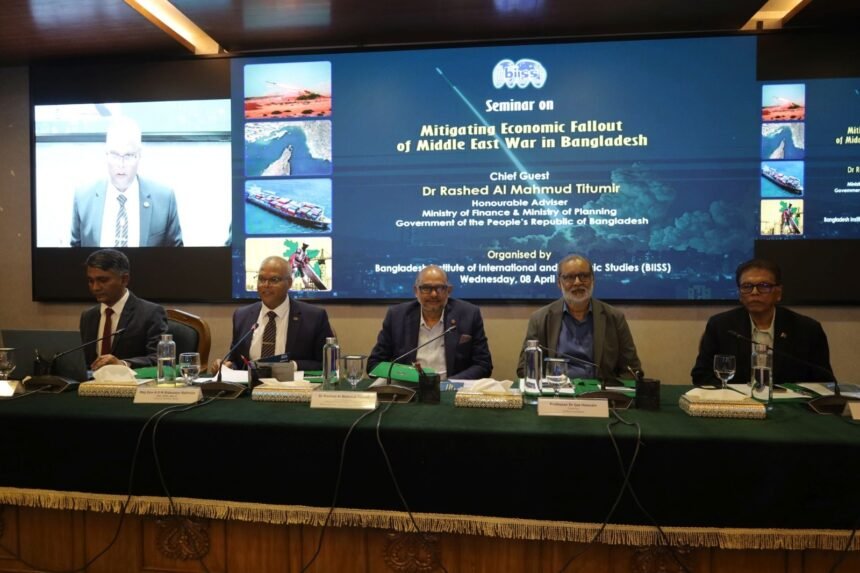
Finance and Planning Adviser Dr Rashed Al Mahmud Titumir said that the war in the middle-east has hit hard economy of Bangladesh hard, as the present BNP government has inherited a crumbling economy, left by the Awami League government.
He was speaking at a seminar titled ‘Mitigating Economic Fallout of Middle East War in Bangladesh,’ organized by the Bangladesh Institute of International and Strategic Studies (BIISS) at its auditorium in the city on Wednesday.
Dr Rashed Al Mahmud Titumir said that the government has been in a catch -22 situation as the energy price has increased sharply in the global market amid war in the middle-east.
He said that 10 per cent inflation, high employment especially among the higher educated youth, drop in real income, camouflage unemployment and rise in poverty level have created vulnerability in the society.
He said that the government has a total commitment to the people of the country that gave a clear verdict in the last parliament election.
He said that the last Awami League government increased the prices of energy several times without considering the sufferings of the common men.
He said the present BNP government can’t whimsically increase the price of the energy as the it has commitment to the people of the country
He stressed that the current economic difficulties must be viewed not just as crises, but as opportunities to implement strategic reforms, drawing parallels to the oil shocks of the 1970s, which forced Bangladesh to rethink its energy policy and economic priorities.
Titumir noted that the country has long lacked a clear benchmark for energy security.
He criticised past administrations, particularly the previous “fascist” regime, for prioritising “crony capitalism” and raising energy prices without sufficient public accountability.
“We saw energy prices artificially inflated to benefit a few. This is not the case now,” Titumir asserted.
Bangladesh, he explained, is actively pursuing a more diversified energy strategy. This includes a balanced mix of fossil fuels, renewable energy, and nuclear power.
He also highlighted that the government had secured financial assistance from international bodies like the IMF, World Bank, and the Islamic Development Bank, to help stabilize fuel imports and trade financing.
“We have enough fuel in the pipeline to manage short-term pressures – 138,000 tonnes of diesel and 71,000 tonnes of octane,” he said.
Titumir also pointed out that the Eastern Refinery, once capable of maintaining a 30-day energy buffer, now only has enough supply for 17 days.
He called for urgent measures to replenish reserves and ensure future energy security.
“We must learn from the past, from countries like Japan that have invested in strategic reserves to endure global crises,” he added.
In terms of macroeconomic adjustments, Titumir discussed how the government is addressing rising poverty, which has affected an additional nine million people in the last year.
Among the steps taken is the introduction of family cards within 23 days of taking office, which aim to deliver social protection based on need rather than political affiliation.
Titumir said that the government will distribute Farmer’s Cards on Pahela Baishakh, April 14 .
He said that the late Prime Minister Begum Zia during the last BNP tenure gave a waiver of agricultural loans to the tune of Taka 5,000.
He termed the decision of current Prime Minister of Bangladesh Tarique Rahman as “revolutionary step” in the cabinet meeting waiving agricultural loans of up to Tk 10,000”
“This is a step towards revitalizing our agricultural base and ensuring that our farmers can continue to contribute to economic recovery,” Titumir explained.
The government is also focusing on “industrial diversification” for future stability with the importance of developing key sectors like agro-processing, pharmaceuticals, leather, and ICT to support long-term economic growth, he said.
About environmental sustainability, he said, the cabinet recently approved measures to promote electric vehicles, including zero duties on EVs for educational institutions and a 20 per cent duty reduction for other sectors.
Titumir also called for a “whole of government approach” to address the country’s economic crisis.
He urged public scrutiny and engagement, noting that the government draws strength from a shared national understanding of the crisis.
The seminar featured several other notable speakers. Inamul Haq Khan, Senior Vice President of the BGMEA, discussed the export sector’s vulnerabilities amid rising energy costs and global instability.
He highlighted a significant decline in trade value and suggested Bangladesh diversify its trade partners, especially towards emerging markets in Africa and Latin America.
Professor Dr Ijaz Hossain, Chairman of ESTex Foundation, focused on the country’s energy crisis, particularly its heavy reliance on fossil fuel imports.
“We must build strategic petroleum reserves to protect ourselves against global price fluctuations,” Hossain argued. He also stressed the importance of shifting towards renewable energy sources and increasing domestic gas exploration.
Dr. Mahfuz Kabir, Research Director at BIISS, discussed the broader economic implications of global geopolitical tensions, particularly the Middle East conflict.
He highlighted the challenges posed by energy price hikes, supply chain disruptions, and a slowdown in overseas employment opportunities.
“The global market is interconnected, and Bangladesh must adjust its macroeconomic policies to stay resilient,” Kabir stated.
Major General ASM Ridwanur Rahman, Director General of BIISS, moderated the seminar, calling for proactive measures to address country’s structural vulnerabilities.